
Making Work Visible: Bridging Operations to NOI & Asset Value
Updated: May 14, 2025
"You have to make it matter to the site staff."
That quote stuck with me, because it echoed something I've come to suspect through years of UX research in multifamily:
The people executing daily tasks may not always see how their work connects to the asset's financial performance.
I'm not in front of clients every day like a Performance Advisor. But based on interviews I've conducted with property managers, leasing agents, operations stakeholders, and other executives, and informed by what I've learned supporting products across the multifamily space, one clear pattern has emerged:
While site teams may hear about NOI, they aren't often shown how it connects to valuation, or how their specific actions (timely unit turns, renewal follow-ups, energy efficiency improvements) shape those outcomes.
And that's not a reflection of disinterest or inability. Most site teams are simply too stretched to track financial impact across so many layers. Many large REITs are now pursuing centralization to relieve site teams of certain administrative burdens, but in speaking with other large, non-REIT firms, it's clear that centralization is far from universal. Industry voices like Jay Parsons with The Rent Roll podcast, and Dom Beveridge with 20 for 20 highlight that while centralized models are expanding, they remain the exception, not the norm.
The Concept: A Performance Kanban
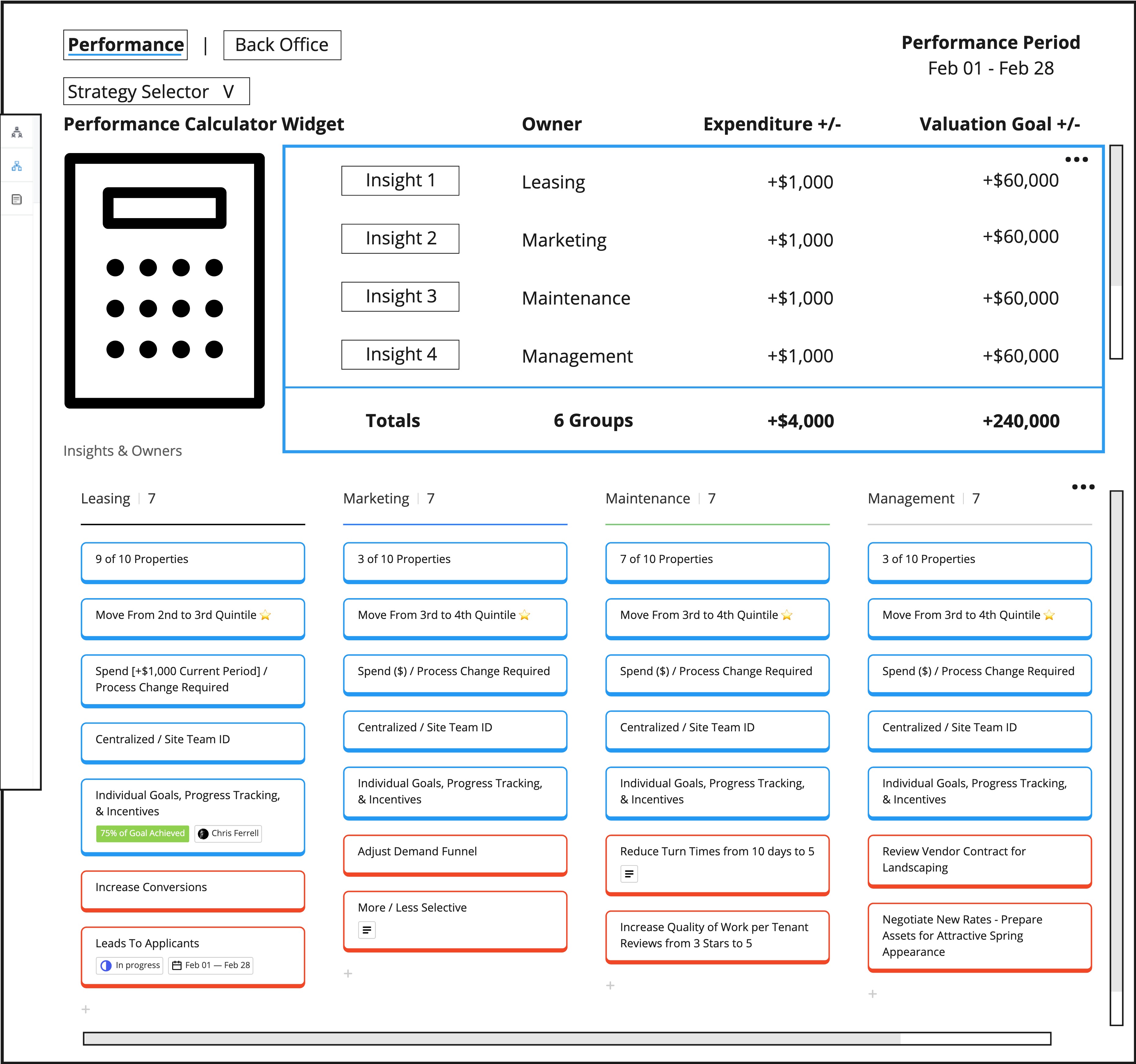
This post introduces a simple visual prototype. A Performance Kanban. It's designed to surface a recurring UX research theme in multifamily:
How do we connect asset-level financial goals like NOI and valuation to the day-to-day work happening on-site?
This proof of concept makes that relationship tangible. It connects:
- Top-line targets (like adding $250K in valuation over 30 to 60 days)
- Functional priorities (leasing, maintenance, collections, etc.)
- Discrete tasks with built-in feedback loops and accountability
And it does so in a way that doesn't require new software. It's a conceptual tool and is adaptable to multiple formats or systems.
Bidirectional Visibility
Visibility isn't just a tool for engaging site teams. It's also a diagnostic lens for leadership. When performance issues arise, this kind of board could help reveal whether the root cause is a local market condition, a staffing or resource gap, or a misalignment in training or process.
Too often, leadership has to infer site-level friction from lagging indicators. This model encourages real-time operational clarity without waiting for escalations or monthly reports.
Why a Kanban?
It's not about jumping on the kanban trend. It's about breaking abstraction. Too often, the metrics that matter most are hidden behind reporting portals or siloed in spreadsheets. This concept brings them out into the open, aligning execution with strategic goals in a format that anyone on the team can read at a glance.
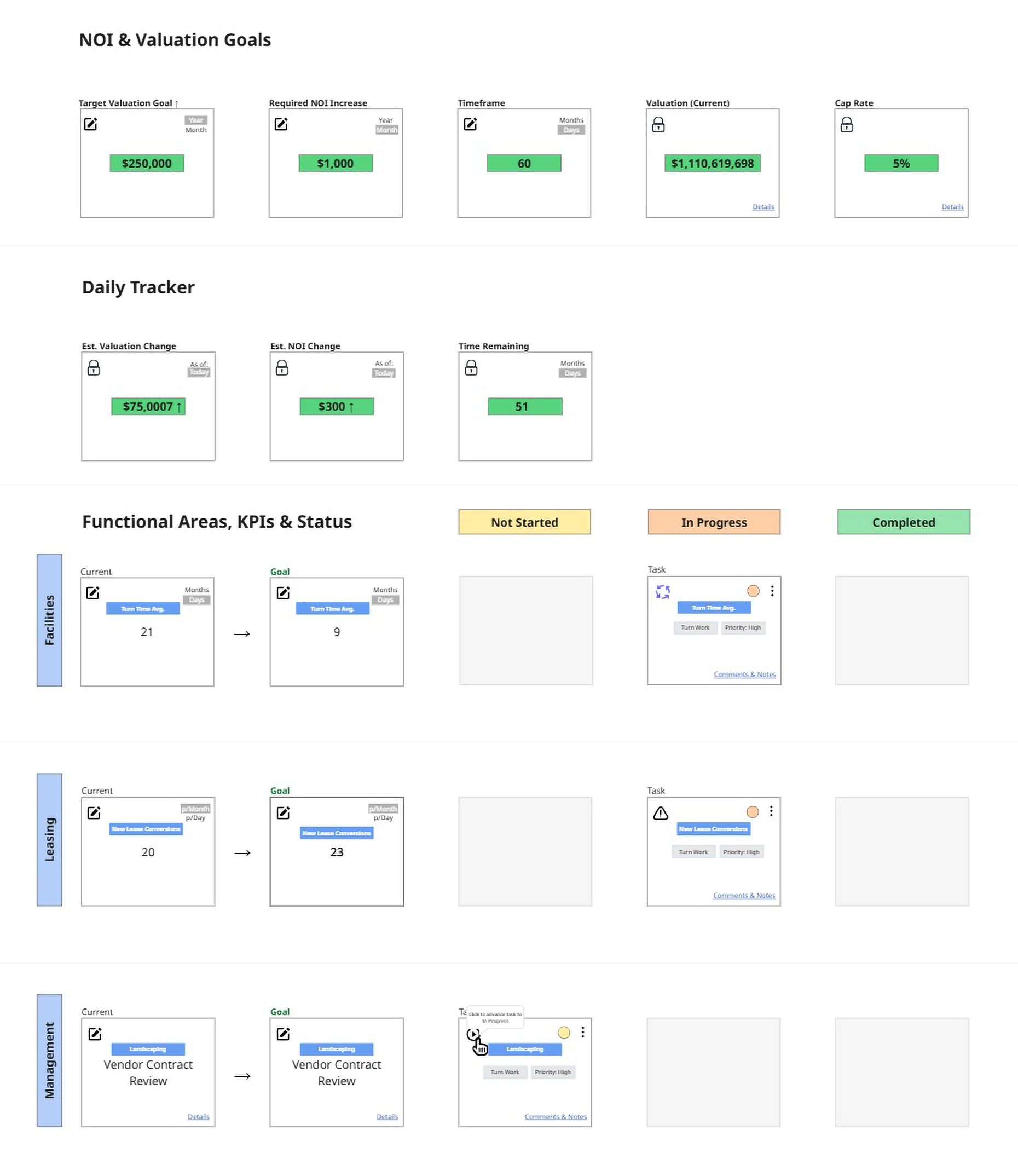
The first layer sets the valuation goal and implied NOI change.
The next layer shows key metrics and who's accountable.
The final layer tracks real tasks through stages of execution.
See the Visual
Here's a snapshot of the prototype:
What This Isn't
This isn't a product. It's not a plug-and-play dashboard or SaaS feature. It's a proof of concept. A reframing of how operations and asset management can communicate with each other.
And I know: not every organization wants complete transparency. There are legitimate reasons some firms may limit how financial goals are shared at the site level, especially in the context of pending exits, asset transitions, or strategic hold decisions.
That's okay. This prototype isn't meant to dictate. It's meant to demonstrate. To show that with even a minimal structure, shared clarity, and by extension impact on desired outcomes is made more accessible.
Final Thought
At its heart, this is about visibility, not just of metrics, but of meaning. When site staff understand how their work ladders up to NOI, they gain more than direction. They gain dignity. And when leadership can see, clearly and calmly, what's happening on-site, they gain the chance to act proactively rather than punitively.
Making work visible is about making work matter. That's what this concept aims to show.
Postscript
As AI becomes a larger part of the operational landscape, the temptation is to automate before we fully understand. But automation only succeeds when the work it replaces or augments is already visible, structured, and trusted. If we want AI to support site teams and leadership alike, we first need shared clarity on what's happening, why it matters, and who it affects. That visibility is the foundation. Until we make the work visible, it doesn't matter who or what we hand it off to.